
WELCOME BONUS 300%
UP TO €2000 + 100
FREE SPINS
UP TO €2000 + 100
FREE SPINS
Home → Blackjack
Blackjack at Slim King Casino
RNG Deals From a Virtual Eight-Deck Shoe
A random number generator feeds a virtual eight-deck shoe, and that shoe depth carries a house edge of 0.46% when the dealer stands on soft 17, doubling after a split is allowed and no surrender is offered. The same rule set with six decks instead of eight returns 99.54%, so the deck count alone moves the figure by roughly 0.02 percentage points. On 100 € of stakes, 0.46% means the casino keeps about 0.46 € per hand on average across a long run, not in a single session.
Against that baseline, a single-deck game with classic rules reaches 99.85% RTP, about 0.31 percentage points above the eight-deck figure and 0.48 percentage points better than a comparable eight-deck shoe. That gain is frequently cancelled by a 6:5 blackjack payout, which cuts the return to 98.15% and lifts the house edge to 1.85%. At 6:5 a 10 € blackjack pays 12 € instead of 15 €.
At Evolution's Infinite Blackjack the virtual shoe runs alongside unlimited seats and four side bets, with an RTP of 99.47% and a bet range of 1 € - 5,000 €. Playtech's Quantum Blackjack Plus Live returns 99.57% with optimal strategy and offers quantum multipliers up to 1,000x on three-card combinations worth 21 points. Both sit above the 99.54% of the plain six-deck basic-strategy game.
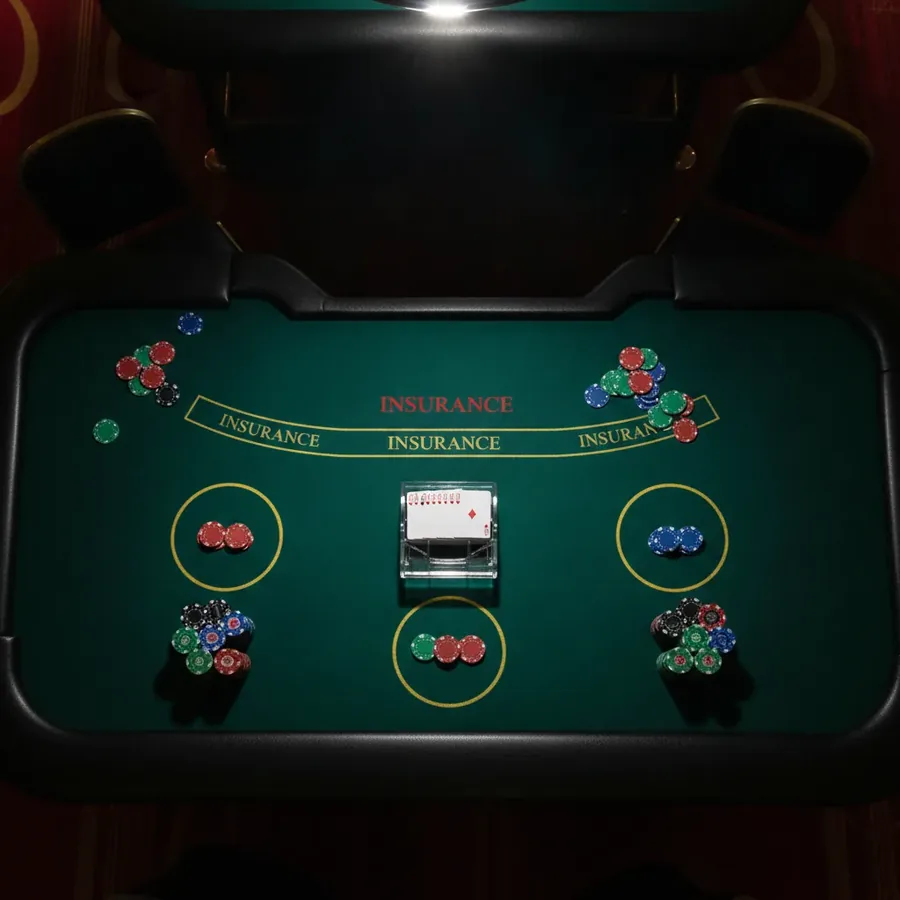
Insurance vs Even Money When You Hold Blackjack
Insurance is a separate side bet of up to 50% of the main wager, offered when the dealer shows an ace, and on six to eight decks it returns 92.53% with a house edge of 7.47%. The payout is 2:1, but the long-run return sits far below the 99.54% of the underlying six-deck game. Basic strategy always declines the bet, with the single exception of card counters at a true count of at least +3.
On a single deck the insurance edge narrows to roughly 5.88%, still far above the 0.15% house edge of the single-deck classic game itself. The gap between 5.88% and 0.15% is what makes the side bet a losing proposition even in the most favourable deck configuration. A 2:1 payout on a 50% side bet does not compensate for the frequency of the loss.
Even money on a player blackjack is the same wager viewed from the other side, and the 3:2 payout it replaces is worth 150 € on a 100 € stake against only 120 € at 6:5. Insurance pays 2:1 but lowers the return over the long run on every deck count covered here. Accepting even money converts a certain 3:2 win into a 1:1 result.
Continuous Shuffling Machines Reshuffle After Every Round
A continuous shuffling machine returns the cards to the shoe after every round, which removes the deck-depth advantage that a single-deck game exploits to reach 99.85% RTP and a house edge of just 0.15%. With the shoe effectively always full at eight decks, the relevant benchmark is the 99.54% and 0.46% edge of the six-deck, S17, DAS, DOA game. The 0.48 percentage points that one deck gains over eight decks never materialise.
Card counting depends on the true count reaching +3, the threshold at which insurance becomes worth taking against a 7.47% edge on six to eight decks. A shoe that is reshuffled after each round keeps the count close to zero, so that threshold is rarely reached. The 92.53% return on insurance applies regardless of how the cards are dealt.
Rule effects still apply on top of the machine: hitting soft 17 adds 0.22 percentage points, resplitting aces subtracts 0.08 and doubling after a split subtracts about 0.14. Choosing 6 decks instead of 8 is worth roughly 0.02 percentage points. None of these modifiers restores the 0.48 percentage points lost by giving up the single-deck shoe.
The Insurance Mistake: 7% Extra House Edge
Insurance on six to eight decks carries an RTP of 92.53% and a house edge of 7.47%, which is 7.01 percentage points above the 0.46% edge of the six-deck basic-strategy game. On a 100 € main bet, the maximum 50 € side bet loses about 3.74 € on average over the long run. The 2:1 payout does not offset that gap.
The same side bet on a single deck shows a house edge of roughly 5.88%, still far above the 0.15% edge of the single-deck classic game. Basic strategy declines insurance in every case except for card counters at a true count of at least +3. That exception is narrow, and it does not apply to ordinary play.
Even money on a player blackjack produces a comparable leak, because it converts a 3:2 payout worth 150 € on a 100 € stake into 120 € at 6:5. The 6:5 rule alone adds exactly 1.39 percentage points to the house edge, taking the return to 98.15%. Repeated errors of this kind cost more per hand than any single rule in the base game.
Blackjack variants at a glance
| Variant | Payout | House edge | Rule | RTP |
|---|---|---|---|---|
| Blackjack Liberal Vegas Strip (liberal rules, 3:2) | Blackjack 3:2, win 1:1 | 0.28% | The most player-friendly rule set: S17 + DAS + resplit + late surrender. Standard deviation 1.15 | 99.72% |
| Blackjack Surrender (late surrender) – rule effect | 50% of the stake returned | −0.08 percentage points | The player gives up the hand after the dealer has checked for blackjack and loses half the stake. Improves RTP by about 0.08 percentage points. Early surrender is worth much more (up to −0.6 percentage points) but is extremely rare. | n/a (rule modifier) |
| Blackjack Split / double / H17 – rule effects | Double – stake ×2 with one card; split – up to 4 hands; split aces usually get one card each. | H17 +0.22 percentage points; RSA −0.08 percentage points; DAS −0.14 percentage points | Dealer hitting soft 17 lowers RTP by 0.22 percentage points; resplitting aces improves it by 0.08 percentage points; doubling after a split improves it by about 0.14 percentage points; 6 decks instead of 8 – about 0.02 percentage points. | n/a (rule modifiers) |
| Blackjack 6:5 payout instead of 3:2 (6 decks) | Blackjack 6:5, win 1:1 | 1.85% | Replacing 3:2 with 6:5 adds exactly +1.39 percentage points to the casino's edge – more than any other rule change. On a €10 bet a blackjack pays €12 instead of €15. | 98.15% |
| Blackjack Insurance (6–8 decks) | Insurance 2:1 | 7.47% | Separate side bet of up to 50% of the main bet when the dealer shows an ace. Basic strategy ALWAYS declines it (except for card counters at a true count ≥ +3). With a single deck the edge is ≈ 5.88% | 92.53% |
| Blackjack 6 decks, S17, DAS, DOA, 3:2 payout, basic strategy | Blackjack 3:2, regular win 1:1, insurance 2:1 | 0.46% | Dealer stands on soft 17; double down on any first two cards; doubling after a split allowed; no surrender. Basic strategy is required to reach this figure | 99.54% |
What the Peek Means When the Dealer Shows an Ace
Peek describes the dealer checking a hole card when an ace is showing, and it directly affects when insurance is offered. The insurance side bet pays 2:1 and allows up to 50% of the main bet, but carries a house edge of 7.47% with six to eight decks. Basic strategy always declines this bet unless a card counter reads a true count of at least +3.
A single deck changes the insurance arithmetic significantly. The house edge falls to about 5.88% instead of 7.47%, because fewer decks alter the proportion of ten-value cards remaining after the ace is removed. That still means a €100 insurance stake loses €5.88 on average over the long run, so the cheaper version remains a poor standalone wager.
The peek itself is neutral for return when the dealer simply checks for blackjack, but the timing of the check decides whether early surrender can exist. Late surrender only becomes available after the dealer has confirmed there is no blackjack, and that rule improves RTP by about 0.08 percentage points. Early surrender, worth up to 0.6 percentage points, is far more valuable but extremely rare.
Six to Eight Decks in the Shoe
Moving from eight decks to six decks lowers the house edge by only about 0.02 percentage points, a marginal shift in the shoe-based game. A six-deck game with S17, DAS, DOA and a 3:2 payout reaches RTP 99.54% when basic strategy is applied, leaving a house edge of 0.46%. The deck count alone is not the dominant factor in the return.
A single deck produces a much larger adjustment of about −0.48 percentage points compared with eight decks, taking the classic-rules game to RTP 99.85% and a house edge of 0.15%. However, operators often offset that improvement by switching the blackjack payout from 3:2 to 6:5. That single change adds exactly +1.39 percentage points to the casino's edge, more than any other rule change in the set.
The practical effect of the 6:5 switch is visible on a €10 stake. A 3:2 blackjack pays €15, while a 6:5 blackjack pays only €12, a €3 difference on every natural. The six-deck 6:5 game shows RTP 98.15% against the 99.54% of the 3:2 six-deck version, so the payout ratio matters far more than the number of decks in the shoe.
Soft 17 Hit vs Stand: 0.22 Percent
Dealer hitting soft 17 raises the house edge by exactly +0.22 percentage points compared with standing. The liberal Vegas Strip set keeps the dealer standing on soft 17 and reaches RTP 99.72% with a house edge of only 0.28%, the most player-friendly rule combination in the comparison. That 0.22-point gap is a direct cost of the hit rule.
Two other rule modifiers work in the opposite direction. Resplitting aces improves RTP by 0.08 percentage points, and doubling after a split improves it by about 0.14 percentage points. A six-deck shoe instead of eight decks adds only 0.02 percentage points, so a player facing H17 loses more than these three favourable adjustments combined can recover.
A standard six-deck game with S17, DAS and DOA returns RTP 99.54%. Adding the H17 rule to that structure would reduce the return by 0.22 percentage points to roughly 99.32%, assuming no other rule changes. The dealer's soft 17 decision therefore costs around €0.22 per €100 staked in the long run compared with a stand game.
Calling Late Surrender Correctly in Three Steps
Late surrender is a rule modifier that improves RTP by 0.08 percentage points and returns 50% of the stake when used. The player gives up the hand after the dealer has checked for blackjack, losing half the wager instead of the full amount. This option appears in the liberal Vegas Strip set, which reaches RTP 99.72% with a house edge of 0.28%.
The first step is to wait for the dealer to confirm there is no blackjack, because late surrender is only valid after that peek. The second step is to surrender only hard totals where the remaining equity is below half the stake, typically hard 16 against a dealer 9, 10 or ace, and hard 15 against a dealer 10. The third step is to keep the surrendered half rather than chasing the hand.
Early surrender, by contrast, lets the player act before the dealer checks and is worth up to 0.6 percentage points, but it is extremely rare on modern tables. The late version remains valuable precisely because it is available in rule sets such as Liberal Vegas Strip, where standing on soft 17, DAS and resplit rights already remove more than half a percentage point of house edge.
Early Surrender Is Gone From Many Tables
Late surrender remains available at blackjack tables with the liberal Vegas Strip rule set, where the player gives up the hand after the dealer has checked for blackjack and loses half the stake. That surrender option improves the return by about 0.08 percentage points, a rule modifier rather than a standalone game. On a €100 stake the surrendered hand returns €50, so the cost of folding is exactly half the bet.
Early surrender is worth much more, up to 0.6 percentage points of house edge, but it is extremely rare. The liberal Vegas Strip rule set instead combines S17, DAS, resplit and late surrender for an RTP of 99.72% and a house edge of 0.28%, the most player-friendly configuration in the comparison. The same table pays a blackjack at 3:2, so a €100 stake returns €150.
A six-deck table with S17, DAS, DOA and a 3:2 payout reaches an RTP of 99.54% and a house edge of 0.46%, with no surrender offered. That is 0.18 percentage points weaker than the liberal Vegas Strip set, or €0.18 more per €100 staked. Replacing 3:2 with a 6:5 payout adds 1.39 percentage points to the house edge, taking the RTP down to 98.15%.
Split, Double Down and Surrender by the Numbers
Doubling after a split is worth about 0.14 percentage points of house edge, while resplitting aces adds roughly 0.08 percentage points back in the player's favour. The house edge is the average share of each stake that the casino keeps, so each of these rule effects moves that share by a fixed amount. A player who doubles after a split puts a second stake of the same size behind one additional card, which is why the option matters so much on a €10 bet.
Blackjack Liberal Vegas Strip carries a house edge of 0.28%, the lowest figure among the six-deck rule sets, and its RTP of 99.72% reflects S17, DAS, resplit and late surrender together. Against that, Blackjack 6 decks with S17, DAS, DOA and a 3:2 payout returns 99.54% and keeps 0.46%, a gap of 0.18 percentage points. On €100 of stakes, that gap is €0.18 of expected cost per 100 rounds played.
Dealer hitting soft 17 raises the house edge by 0.22 percentage points, more than the 0.14 percentage points that doubling after a split gives back. Resplitting aces and late surrender each contribute 0.08 percentage points in the player's favour. A six-deck game therefore edges 0.02 percentage points below an eight-deck game with the same rules, so the deck count alone is a minor term next to the soft-17 rule.
Soft vs Hard Hands in Practice
A dealer who stands on soft 17 is the S17 condition in Blackjack Liberal Vegas Strip, whose RTP of 99.72% and house edge of 0.28% sit at the most player-friendly end of the six-deck variants. A soft hand contains an ace counted as 11 without busting; a hard hand has no such ace. The same rule set also includes DAS, resplit and late surrender, which is why the edge stays below one percent.
Under H17, the dealer hits soft 17, and that single change lowers RTP by 0.22 percentage points. Blackjack 6 decks with S17, DAS, DOA, a 3:2 payout and basic strategy returns 99.54% and keeps 0.46%. The 0.22 percentage points sit inside that 0.46%, so nearly half of the six-deck house edge comes from the soft-17 rule rather than from the deck count.
Basic strategy is required to reach the 99.54% figure on the six-deck S17 game; without it the return drops. Insurance pays 2:1 and is always declined under basic strategy, since its own RTP of 92.53% leaves a 7.47% house edge on six to eight decks. A €100 insurance bet therefore costs €7.47 on average across many rounds, far above the 0.46% on the main hand.
A Side Bet Every Round: The Budget Lasts 30 Rounds
Insurance on six to eight decks returns 92.53% and keeps 7.47%, and it may be taken for up to 50% of the main bet when the dealer shows an ace. On a €100 main bet the maximum insurance stake is €50, and that €50 carries an expected cost of €3.74. Basic strategy declines the bet in every case except card counters at a true count of +3 or higher.
Infinite Blackjack from Evolution carries an RTP of 99.47% and four side bets: Any Pair, 21+3, Hot 3 and Bust It. The main game's 0.53% edge on a €10 bet is €0.05 per round, while a side bet placed every round adds its own cost on top of that figure. Over 30 rounds, €10 of main stakes produce about €1.60 of expected cost at the main-game rate alone.
Quantum Blackjack Plus Live from Playtech returns 99.57% with optimal strategy and offers quantum multipliers up to 1,000x on three-card combinations worth 21 points. Blackjack Party from Evolution spreads bets from €1.00 to €1,000 and pairs two hosts with the table. A single-deck classic game at 3:2 reaches 99.85% and keeps 0.15%, and that lower edge is often offset when the payout is cut to 6:5.
Surrender or Play On With 16 Against a 10
Late surrender returns half the stake after the dealer has checked for blackjack, and it improves RTP by about 0.08 percentage points. On a €10 bet the player gives up the hand and gets €5 back instead of playing it out. That fixed 50% return is why the option is worth taking on the weakest starting hands.
Early surrender is worth far more, up to 0.6 percentage points, but it is extremely rare on modern tables. Blackjack Liberal Vegas Strip includes late surrender inside a rule set with S17, DAS and resplit, giving 99.72% RTP and a 0.28% house edge. The surrender modifier alone accounts for 0.08 of those percentage points, roughly 29% of the total edge that remains.
On a 16 against a dealer 10, playing out wins only when the dealer busts or the draw improves the hand, and the alternative is a guaranteed half stake back. Insurance pays 2:1 but returns only 92.53% over six to eight decks, so it is a worse use of the same €10 than the surrender option. Blackjack Single deck with classic rules and a 3:2 payout returns 99.85% and keeps 0.15%, the lowest edge among the single-deck sets.
Side Bets Raise the House Edge to 5%
Insurance on six to eight decks returns 92.53% and keeps 7.47%, the highest edge of any bet named among the blackjack options. A €10 insurance stake therefore costs €0.75 per round on average, against €0.05 for the same €10 on Infinite Blackjack from Evolution at 99.47% RTP. Repeated every round, that difference compounds quickly.
Infinite Blackjack from Evolution spreads bets from €1 to €5,000 and adds four side bets: Any Pair, 21+3, Hot 3 and Bust It. Quantum Blackjack Plus Live from Playtech spreads the same €1 to €5,000 range and returns 99.57% with optimal strategy. Blackjack Party from Evolution runs from €1.00 to €1,000, a narrower upper limit than the other two live tables.
Blackjack 6:5 pays €12 on a €10 blackjack stake instead of €15, and replacing 3:2 with 6:5 adds exactly 1.39 percentage points to the casino's edge, more than any other single rule change. That variant returns 98.15% and keeps 1.85%. A 300% welcome bonus up to €2,000 plus 100 free spins on a €50 deposit produces €150 of bonus money and a €200 balance, but the 1.39-point payout cut applies to every blackjack dealt at 6:5.
Contact
Live - online chat
Banking









Providers












Slim King Casino 2026